
What Does Phase Mean In Audio Recording?
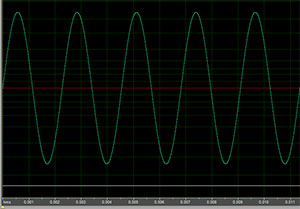 Phase is a pretty importance concept in audio recording. It affects how different sounds – like instruments, voices, etc. interact with one another. It also affects how the same wave interacts with other versions of itself, created by delay effects or by room reflections when it comes out of a speaker and bounces off the walls and ceilings.
So what is phase? First it’s important to remember that sounds are waves, like the one in the picture on the left. These waves are made by air molecules being pushed around. That red line across the middle of the wave in the picture represents silence – no air molecules vibrating. The peaks on the top part of the graph are the positive pressure parts of the sound wave, made when air is being pushed into or toward a microphone. The bits underneath the red line are the negative waves made by air moving away from the microphone. I talked more about this in the recent article – Using The Polarity Switch To Optimize Live Drum Sound. Whether a wave is positive or negative is its polarity. I mentioned in the Polarity Switch article that the term phase is often mistakenly used in place of the term polarity. So now that you know what polarity is, you’ll understand after this article why phase and polarity are often conflated.
So what is Phase?
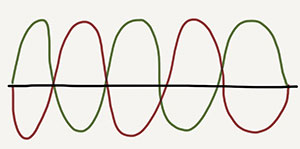 Phase is about the relationship between two or more waves. So if we had an exact duplicate of the above wave playing at the same time, they would be in phase, and the amplitude (how high or low the wave is) would be doubled. If this same duplicate wave were moved in time, however, by just the right amount (that is the red one in the lower picture to the left), then the two waves would be completely out of phase with one another and the amplitudes would cancel each other out. Of course any difference in timing between these two identical waves would be considered out-of-phase (just not “completely” our of phase) and some cancellation would still happen.
If wave number two (the red one) were now to have its polarity “flipped” (reversed), it would be back in phase with the first wave. Get it?
Now imagine different types of waves from different sound sources all playing at the same time. If you’re not careful, certain sounds might combine to cancel out some sounds and increase others. We can use things like time delay, EQ, and the polarity switch on mix channels (usually mistakenly called the phase switch) to help us deal with phase issues.
Here is an excellent article that goes into more detail about phase and how it concerns recording and mix engineers:
https://www.prosoundweb.com/article/in_the_studio_techniques_for_dealing_with_phase/