
Phoenix on Saturday Night Live – Double-Tracking The Lead Vocal
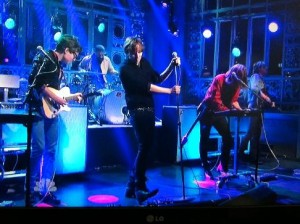
Did you notice the sound of the lead vocalist, Thomas Mars, on Saturday Night Live (April 6th, 2013)? That is the sound of double-tracking, or since it was a live performance, it would just be called “vocal doubling.”
Double-tracking a lead vocal is a really common technique used mostly in recording. You probably never heard a Beatles song without it. But when performing live, it’s much less common.
There are two primary ways to get the sound of a double-tracked vocal. You can either have the lead singer actually sing the part twice, which is actually more common these days when recording (obviously impossible live, at least without some creative vocal surgery;)).
Or you can do it electronically with an effect box. The Beatles actually started with the singing-the-part-twice method, then moved to an automated way to do it (artificial double tracking – ADT), since John Lennon did not like singing his part twice, or so the story goes. See my article What The Beatles Can Teach Us About Mixing Music for more on this.
The reason for even doing the double-tracking thing is to create a nice, thick sort of chorus-y sound on the voice. That sound is very distinctive once you know what to listen for. And I most definitely heard it from Thomas Mars last night.
It could have been the automated effect being used. But there may have also been an actual recorded version of the lead vocal coming over the PA that Thomas Mars sang along with to create the effect. I have no evidence one way or the other.
However, as you can see in the picture above, Thomas had a bank of effect pedals that he is stepping on, which I strongly suspect were for chorusing and/or double-tracking.
But even if he did have a pre-recorded version to sing along with, I need to point out that this is NOT the same thing as lip-syncing, where the recording is all the audience hears while the singer fakes the actual singing.
With double-tracking, you actually hear the live vocal as the singer sings. It’s just that it is augmented by a recorded version as well.
Either way, I have no problem with it at all as long as the performer is actually performing live.
So if you didn’t know what double-tracking sounded like, now you do. And if you need to thicken up the sound of a lead vocal, you know how to do it.
There are tutorials on double-tracking in our home recording course, The Newbies Guide To Audio Recording Awesomeness.
If you watch the Phoenix Live on KCRW 2013 video, you can see him adjusting the doubling processor he keeps at arms length. It’s either a doubler or an actual recorded vocal track that he is self-mixing. I couldn’t tell if they were playing to some sort of synch. I was also listening to see if the two vocals ever got off pitch from one another, which would lend me to think they are using a recorded vocal track. There are also times he backs off the mic on some high notes. It’s perfectly understandable to me that they would do a recorded track due to the rigors of live performing and wanting to keep a quality product on stage every night. After a second listen, it almost seems like a doubling effect because his off pitch notes were replicated in the effect. He was also stomping on some foot pedals. Check it out and let us know what you think. The song Drakkar Noir actually seems like a doubling effect and he is controling the mix of either the effect or the mix in his headphones.
i was so upset when i saw people accusing phoenix of lip syncing. to a backing track. it is in no way shape or form karaoke. thanks for this post. I love doubling and do it almost all the time. its usually more subtley done than what he used it live but it made me start mixing my music with heavier doubles cause i like the sound so much. it reminded me of my favorite bands ice choir and violens with their 80s new wave post punk appeal. also a hint of smiths or something in there.
by the way the effects box is some sort of tc helicon product. they have a bunch of live pedals for effecting vocals that includes reverb, distortion, tone, doubling, harmonies, delay, and more. i think specifically in the kcrw 2013 its a voicelive touch unit (they now have a voicelive touch 2) that has an attachment to connect to the mic stand that it comes with i believe. they also make pedals that can store presets and have a more vast set of effects and you can see james blake us it live on Lindisfarne for his r&b-ish effected vocals. a great watch live. I’ve seen them both live and the units sound great in the scenario not just through video.
Thanks for the comment, Max!